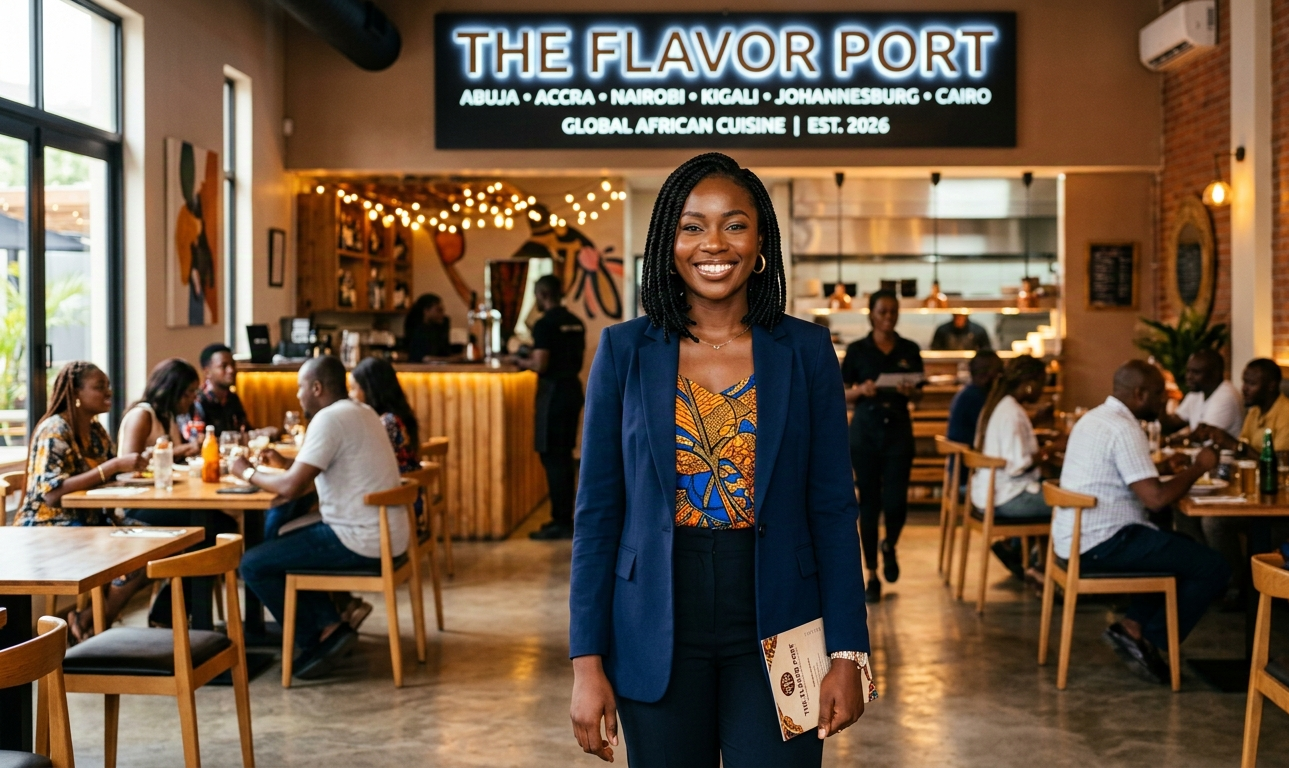
The sun in Abuja doesn’t just shine; it makes a statement. In the bustling heart of Wuse 2, where the air is a thick blend of diesel exhaust and the scent of roasting suya, 25-year-old Mary Amadi stood in front of a boarded up storefront. Most people her age were navigating the labyrinth of entry level corporate jobs or figuring out their post-NYSC (National Youth Service Corps) lives.
Mary, however, was holding a set of keys and a vision that was far too large for a single plot of land in Nigeria’s capital.
This is the story of how a young woman turned a single kitchen into a continental empire, proving that African flavors don’t just belong in home kitchens they belong on the global stage.
The Genesis: Abuja’s “Flavor Port”
In 2026, Mary Amadi opened The Flavor Port. While the name sounded international, the soul of the restaurant was deeply rooted in her grandmother’s kitchen in Enugu. But Mary wasn’t interested in just serving traditional plates; she wanted to elevate them. She has always the type of girl who wants to show the world her talent in cooking and also motivate other young women to be the woman they want to be.
Opening a business in Nigeria at 25 is not for the faint of mi heart. Mary faced a trifecta of “Nigerian Factors”:
Infrastructure Hurdles: Relying on generators when the national grid took its frequent naps.
Skepticism: Suppliers often asked to speak to “the boss,” assuming a woman this young couldn’t possibly be the owner.
Logistics: Sourcing consistent, high-quality produce from local markets while navigating Abuja’s traffic.
Mary’s “secret sauce” wasn’t just in her recipes; it was in her standardization. She treated her kitchen like a laboratory. Every spice mix was measured to the gram; every plate was a work of art. By her 26th birthday, The Flavor Port wasn’t just a restaurant it was a landmark.
The Continental Leap: 5 Countries, 5 Flavors
Success in Abuja was the proof of concept. But Mary’s ambition was pan-African. Within five years, she didn’t just open branches; she localized a movement. She looked at the African Continental Free Trade Area (AfCFTA) not as a policy document, but as a roadmap.
1. Accra, Ghana: The Jollof Diplomacy
The first stop was obvious. Mary moved to Accra to bridge the gap. Instead of reigniting the “Jollof Wars,” she created a “Unity Jollof” that combined the smoky depth of Nigerian party rice with the aromatic finesse of Ghanaian basmati. It was a hit, and it taught her the most valuable lesson of expansion: Respect the local palate.
2. Nairobi, Kenya: The Tech-Food Fusion
In Nairobi, Mary leaned into the city’s “Silicon Savannah” reputation. She launched a tech-integrated dining experience where customers could track the farm-to-table journey of their Nyama Choma tacos via a QR code.
3. Kigali, Rwanda: The Efficiency Model
Rwanda offered Mary something every entrepreneur dreams of: ease of doing business. In Kigali, she perfected her franchise model. The restaurant there became the training hub for her African staff, emphasizing the “Amadi Standard” of hospitality.
4. Johannesburg, South Africa: The Southern Soul
Jo’burg was a different beast. The market was sophisticated and highly competitive. Mary pivoted her menu to include “Pan-African Tapas,” allowing diners to taste a bit of Lagos, Nairobi, and Accra in one sitting. It became the go-to spot for the city’s cosmopolitan crowd.
5. Cairo, Egypt: The North African Gateway
The final piece of her five-country expansion was Cairo. This was her biggest challenge blending West African heat with Middle Eastern spice profiles. She introduced “Suya-spiced Kebabs,” a fusion that took the city by storm and proved that African cuisine is a spectrum, not a monolith.
The Amadi Blueprint: Success at a Glance
What does it take to scale like Mary? It wasn’t just about good food. It was about business grit. She was so determined to establish her business and become her own boss even when her friends looked down on her and told her she might quit one day because it is not easy to run a business in Nigeria but she never listened to them.
Overcoming the “Young Female Founder” Bias
Mary often jokes that she spent her first two years in business wearing “seriousness like a garment.” She had to be twice as prepared and three times as firm as her older male counterparts.
“People expect a 25year-old girl to be running a ‘side hustle’ or a ‘hobby,’” Mary said in a recent interview. “They don’t expect a CEO who understands EBITDA, supply chain logistics, and cross border taxation. I had to stop asking for a seat at the table and just build my own restaurant.”
Her success has dismantled stereotypes across the continent. In every city where The Flavor Port opens, Mary hosts a “Founder’s Table” a monthly dinner where she mentors young local women looking to break into the hospitality and agricultural sectors.
The Legacy of The Flavor Port
Today, Mary Amadi is more than a restaurateur; she is a cultural ambassador. She has proven that Nigeria’s greatest export isn’t just oil or Afrobeat it’s the sheer, unadulterated “can-do” spirit of its youth.
Her expansion across five African countries has created over 1,200 jobs and provided a platform for hundreds of local farmers. She didn’t just export Nigerian food; she exported the idea that Africa can feed itself and the world with style, dignity, and a whole lot of spice.
Looking Ahead: The Future is African
As Mary looks out over the Cairo skyline from her newest rooftop location, she isn’t thinking about stopping. There are whispers of London, New York, and Tokyo in the pipeline. But for Mary, the goal remains the same as it was that hot afternoon in Wuse 2: to make people feel at home, one plate of perfectly seasoned food at a time.
Mary Amadi didn’t just build a restaurant chain. She built a bridge across a continent, proving that while our languages and borders may differ, the language of a good meal is universal. At 31, with six countries under her belt, Mary is just getting started.
The hearth is lit, the table is set, and the world is finally hungry for what Africa is serving.
Leave a Reply